


ASK THE DOCTOR: The Beethoven Dog Project
Music is good for us. This is a little hard to study with the same rigor as, say, whether penicillin or another antibiotic is best for a specific infection, but music has been studied and the physiological benefits are measurable.
Music can reduce stress, blood pressure, pain and anxiety. Sometimes music can be a way to communicate and interact with someone who has lost the ability to speak or understand language. Music is certainly a way to connect with emotions.
Singing likely came before spoken words. Lullabies are used to soothe babies across all cultures. True, some people don’t respond well to music — including author Vladimir Nabokov (who ironically has a musical style of writing). But for the most part, music is a universal that tends to connect all parts of human experience, from celebration to mourning, and can improve our ability to learn, retain memory and remain healthy.
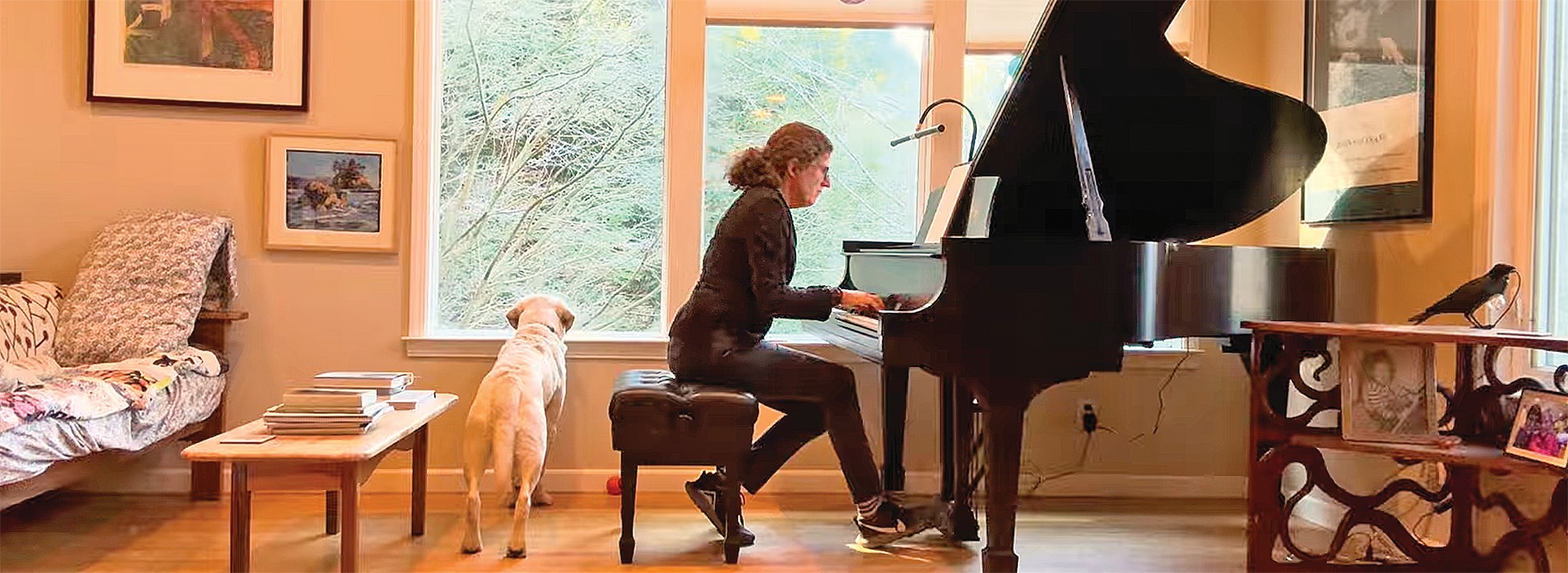
Recently I became interested in how dogs might respond to music, in particular Beethoven, a favorite of mine. I have long wanted to record all 32 of his piano sonatas and decided to do it with one requirement: a dog (or dogs) must always be in the audience. As of this writing I have completed videos of seven sonatas for a variety of canines — our dog, Monk, and his friends.
Their response has varied from running around the room to gazing thoughtfully into space to immediately falling into a deep sleep. I cannot honestly say whether these dogs have any real clue what is going on, but my observation over years of playing my piano for my own dogs is they all seem to find it reassuring. Although Zoe, a golden doodle we lived with some years ago, absolutely had a preference for anything pre-Brahms. She would run down the hall to sit at my feet when I would sing my children to sleep. She lay contentedly at my feet for Bach and Beethoven. But she would run away if anything even the slightest bit overly romantic or atonal emanated from the piano.
Music, medicine and mathematics often coincide and overlap in human brains (though my brain seemed to skip the mathematics part). Many doctors play music. I am not entirely sure why, but it could have something to do with the personality trait that makes you willing to sit for hours on end learning something very detailed. Music students sit in practice rooms, medical students sit in study carrels.
I have always found it helpful to have music playing while I study, as it seems to help me solidify information in the memory banks. In fact, for one of my biggest histology exams in medical school, I was listening to a lot of Verdi, and his music is now forever entwined with pictures of the cellular structure of people’s internal organs — eosin stain meets Italian operatic strains.
Music is also a place to develop attention and focus, as well as physical coordination. Music programs in schools, always one of the first things to go when budgets are stressed, can improve academic performance in all areas. A rhythmic beat can help a person with Parkinson’s disease walk with less hesitation. A person who can no longer speak might still be able to sing.
The brain has a deep epigenetic musical history, likely going back thousands of years to our earliest ancestors. I recommend the work of Oliver Sacks, a neurologist who wrote about the way music can affect the brain in normal and disease states, particularly his book “Musicophilia.”
As for the Beethoven Dog Project, I can reliably report only on the human half of the experiment.
Performing on the piano has been a lifelong activity for me. When I left the pursuit of music as a career to study to be a physician, I initially stopped playing altogether, as the loss of technique was painful (no longer being able to practice six to eight hours a day). Luckily, I came to my senses sometime after completing my medical residency training and decided to start playing again. Now I am quite comfortable just enjoying the music and sharing it with others — including dogs — when I am able.
This project has given me great joy, even when other things in life have been difficult, and has had the added benefit of spending time connecting with some sweet animals.
If I happen to add anything to their health, that’s even better. At the very least, I hope I am expanding their neural networks. Maybe listening to Beethoven makes them even better at remembering exactly where they buried that delicious bone!
One last thing: it is never too late to play, sing or enjoy music. Check out the Metropolitan Operas when they are aired in real time at the Minor Theatre in Arcata [see Roy Grieshaber, “Live Opera,” page 21]. Tune in to the radio. Buy an album or CD. Download some songs. Go to a live music performance. Have a dance party in your home. Find a piano teacher. Learn the ukulele. Join a choir. Sing in the shower. Sing to your children or grandchildren.
Sing to your dog. I’m not sure about your cat — I suspect they have strong feelings about music and are not afraid to tell you about them. I picture cats being most fond of punk rock. But the truth is that there would be no punk rock without Beethoven. I will argue that one to the end of my days.
Dr. Jennifer Heidmann is chief medical officer at Humboldt Senior Resource Center and Redwood Coast PACE (707-443-9747). This column should not be taken as medical advice. Ask your medical provider if you have health questions. Send comments to SN@humsenior.org. Join Monk, Sammy, Flora and the Beethoven Dog Project concerts on YouTube @jenniferheidmann4984.