


My Singing Career
My mother learned how to read music. Her best friend was a musician and explained treble clefs, bass clefs and how to count time depending on the kind of note you saw. She showed Mom where middle C was on my grandmother’s old upright piano.
My mother would determinedly try to plunk out a tune. I got to press the ivory keys sometimes, but my hands were too small. I did remember where middle C was.
Sometimes when I got out of school, I went with Mom to her singing practice and had to be quiet and just listen. The director lady kept telling them how to breathe and sing at the same time. They rehearsed the songs over and over.
At home, my mother got her Singer sewing machine out and sewed up a storm. When they performed, everybody wore a long dress and floppy hat, just like ladies at the turn of the century. The Mothersingers sang at meetings at the Veterans Memorial Building, the Masonic Temple and for patients in local hospitals and nursing homes.
Every year, the state’s Mothersingers groups held a convention. To help raise travel money, they planned a Gay Nineties Review in the Eureka Junior High School auditorium. Not only would the group sing, but other acts were added, too — just like an old vaudeville show. The show would end with a can-can! Admission was 60¢ for adults and 35¢ for kids.
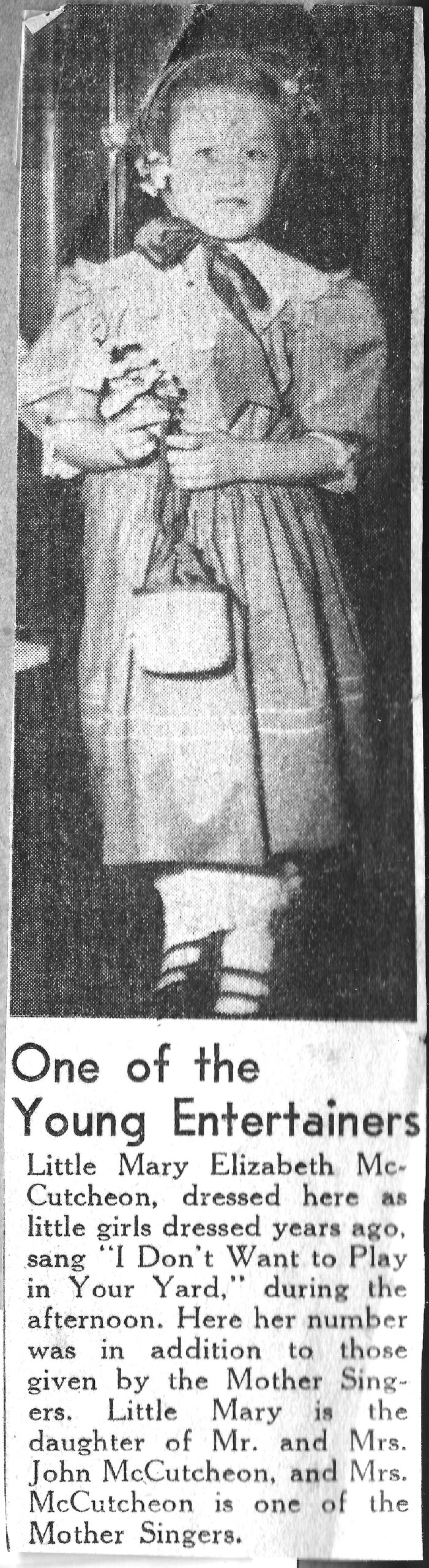
Somehow, I got recruited to sing. My mother got busy with her sewing machine and I ended up in a bonnet, a long dress and pantalets.
On the blue mimeographed show bill, I was listed as “Cooky McCutcheon, Child Protégé.” My performance was sandwiched between a male quartet and a married couple singing a medley. At least I didn’t follow the ventriloquist with the dummy.
My song was the chorus part of “I Don’t Wanna Play in Your Yard.” Eight lines. It was written in 1894 and had to do with two little girls arguing. The lyrics confused me. I had no idea why anybody would want to climb down a cellar door or holler down a rain barrel, but I sang it anyhow.
I remember very little about the performance. There was a real bright light somewhere above me and my mom’s friend was sitting at the piano mouthing the words for me. I couldn’t see the audience hiding in the dark. It was the can-can ladies who were the funny, big hit anyhow.
I never had to do that again. Neither did the five mothers who did the can-can.
Mary McCutcheon still lives and sings in Eureka.